Agentic Onboarding: Tackling Adoption, Utilization, and Time to Value
Conversion was working — but adoption was broken. 40% of new customers were getting access to HubSpot's quoting tool and doing nothing. I pushed for this project during a company-wide end-of-year quality sprint — and was given one week to implement something. The experiment I shipped in that window became a framework adopted across the entire Commerce product suite.
400%
faster first quote acceptance (24 days —> 6 days)
467%
faster first quote creation (17 days —> 3 days)
24%
increase in overall accounts with seats assigned
10%
increase in overall accounts with quotes shared or accepted


Context
Users didn't know where to start after purchase.
The upgrade redesign was working — users were converting. But the team's core success metric was five or more quotes shared per account, and 40% of new customers were dropping off right after getting access without ever reaching it. Quiet churn. Only 63% had given their sales team access to the tool. First quote creation averaged 17 days; first acceptance, 24.
The original team responsible for adoption had been reassigned to feature work. I identified this as the most impactful problem to solve and pushed for it. I made the case, won the project, but was given one week to ship this project along with other high impact projects. To add to the challenge, my PM had just left for maternity leave, and I was working with a brand new lead developer — effectively running the team while delivering the experiment.
After spending time in the data and with users, the problem was clear: Nobody was telling users where to start. The product had no opinion or clear path about what to do first. So people didn't do anything.
My Role
Design Lead · Product Manager
Team + Stakeholders
Scope
Problems → Opportunities
PROBLEM
Customers paid for the tool but didn't know they had to set it up before anyone could use it
After purchasing, account administrators had to assign seats — giving individual team members access to the quoting tool — before any sales rep could create a single quote. This wasn't obvious. Many customers skipped it entirely. Only 63% of purchased accounts had ever assigned a seat, meaning 37% of paying customers had a tool their team couldn't actually use.
OPPORTUNITY
Make seat assignment the mandatory, explicit first step
Seat assignment was moved to the very start of the onboarding sequence. Sales reps also received a guided prompt to request access to seats.
PROBLEM
The product had no opinion about how to start — so customers did nothing
After getting access, users had no guidance on where to start. With no clear goal and no obvious first action, 40% of new customers dropped off without ever sending a quote.
OPPORTUNITY
Create an onboarding framework to surface crucial steps
Admins were shown crucial steps to get their team up and running immediately. Sales reps were shown steps to either prompt admins to give them access, or that prompted the sales user to perform a task.
The Experiment
The experiment's results were clear
There was concern about what step order would be most impactful for administrators. Quote templates were required to create quotes — the action that we based Time to Value on — but products were important to many quotes. Products could be added to the quote by anyone, but templates could only be created by admins. My hypothesis, that quote templates should be set up immediately after assigning seats, proved true.
Final Designs
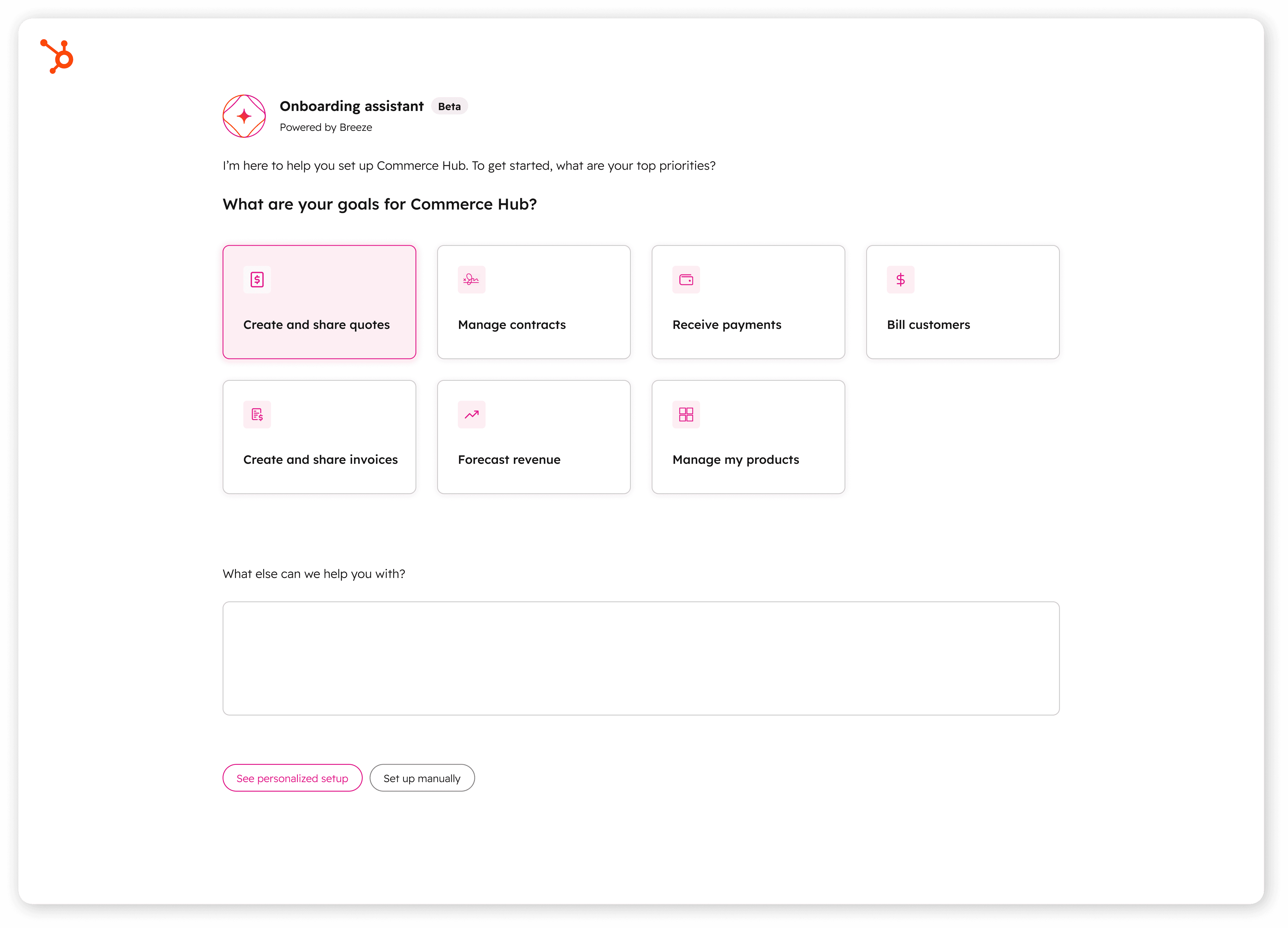
The experiment became an AI-powered, hub-wide onboarding framework.
This experiment was built specifically for onboarding to the quoting tools, but due to its success, the rest of the hub adopted this framework for their tools as well. An AI assistant was added to determine their onboarding needs.
01
AI-powered onboarding
The flow was updated to include an AI assistant that could help admins identify what steps they needed to get set up.
02
An introductory modal provides awareness
Previously, there was no way to let users know that they had been upgraded — admins and regular users alike. Now users are greeted and can expect changes.
03
Seat assignment was the first step
To help with time to value, seat assignment was a crucial first step that was not previously surfaced to customers. This unlocks the upraded features for any user that is assigned a seat.

04
Payments and billing steps were added
Initially, the steps focused on setting up quotes — more detailed information about setting up payments and billing was added once the experiment proved out.
The success of Opinionated Start was so profound that the rest of Commerce Hub — payments and billing — used it as a framework to onboard their areas of the product as well
Outcomes
What moved.
Time to Value
400%
faster first quote acceptance
24 days —> 6 days
467%
faster first quote creation
17 days —> 3 days
280%
faster purchase to first quote acceptance
19 days —> 5 days
10%
increase in overall accounts with quotes shared or accepted
Engagement and Revenue
24%
increase in overall accounts with seats assigned
19 days —> 5 days
Previous Growth Metrics
27%
increase in tool usage
After fixing a confusing task list that was causing drop off
132%
lift in payment enrollment starts
100%
sustained increase in payment enrollment starts
$28M
payment volume from account migrations